Sunday, June 7, 2015

The Inheritance of Loss - Kiran Desai

This one was an adorable read and I would've absolutely loved to devote more time to writing a more detailed piece on my view of Kiran Desai's Man Booker prize winning novel. 

But alas! The Ibis beckons. 

One must leave all else and head for port this instance, where lies that magnificent ship, waiting for this humbled reader to be transported back to the China of 18th Century that I last had the opportunity of visiting nearly four years back- thanks to the spectacular storytelling ability of a certain white-haired Bong.

So I'll keep it short and sweet, just like Desai's writing.

The book reminded me of Ruskin Bond. It reminded me of a certain short story that I had read of his as a kid- about another kid living at the foothills of the Himalayas who sows peaches and then sees a peach tree grow from his sowing over the years as his own self transforms first into a teenager and then into a sturdy young man.

While there is nothing common between Desai's book and Bond's short story (if you ignore the similar setting, that is), there is still that special sort of innocence that both seem to radiate onto the audience from start to finish; an innocence that generally does not come so naturally to most writers and hence that remains, in turn, a rare experience for the readers to find and cherish.

Of course I would be doing the authoress a great dishonour if I stopped here, at the comparison of her full-fledged novel to a shortie- no matter how good the latter happens to be. So, I must elaborate a little further- Desai manages to bring to the table a heck lot more than just innocence. Her scope is wide and the span of her tale long, even if sequenced in a non-linear fashion.

Her backdrop is not only the beautiful physical setting (a crumbling house at the foot of Mount Kanchenjunga is where the story begins) but also the spurt of a movement in Darjeeling and surrounding areas demanding a separate state for Gorkhas. Trouble is brewing in this paradise. The kind of trouble that can bring down both nature and men alike.

'The Inheritance of Loss' addresses issues of different scales with great poise such that even when the conflict between people for and against Gorkhaland becomes much more overt in the third act, the main ensemble of characters that include a lovelorn teenage girl, her Nepali tutor cum lover, her grumpy grandfather who has a history of bottled-up rage, their eccentric cook, his son living abroad as an illegal immigrant and the other residents of Kalimpong always occupy centre stage. There is emotional heft in their dialogue with each other (a disrupted telephone conversation between the cook and his son calling from abroad was such a tearjerker, I had to just put down the book for lack of a more isolated milieu) The characters and their varied points of view are what make the backdrop- both natural and human- come alive so effectively.

And the writing... like a gentle breeze that plays at your nape as you sit under a hot afternoon sun, praying to all three hundred and thirty million gods for respite from the heat.

Such natural elegance!

A special mention for Desai's loving portrayal of Mutt, the Judge's pure-bred pet dog and Mustafa the cat. How I wish atleast one of them was lying next to me right now, grrrrring, meowing, staring languidly at my moving fingers as they type these final words of a review that, I am aware, has failed miserably in doing justice to the book that is nothing but a product of immense love and much more immense literary talent; a book that I will certainly be revisiting shortly.

Verdict: I will thoroughly recommend Kiran Desai's The Inheritance of Loss to anyone who enjoys his or her food warm and his or her drink cold. All others, if any, are exempted.


Saturday, May 30, 2015

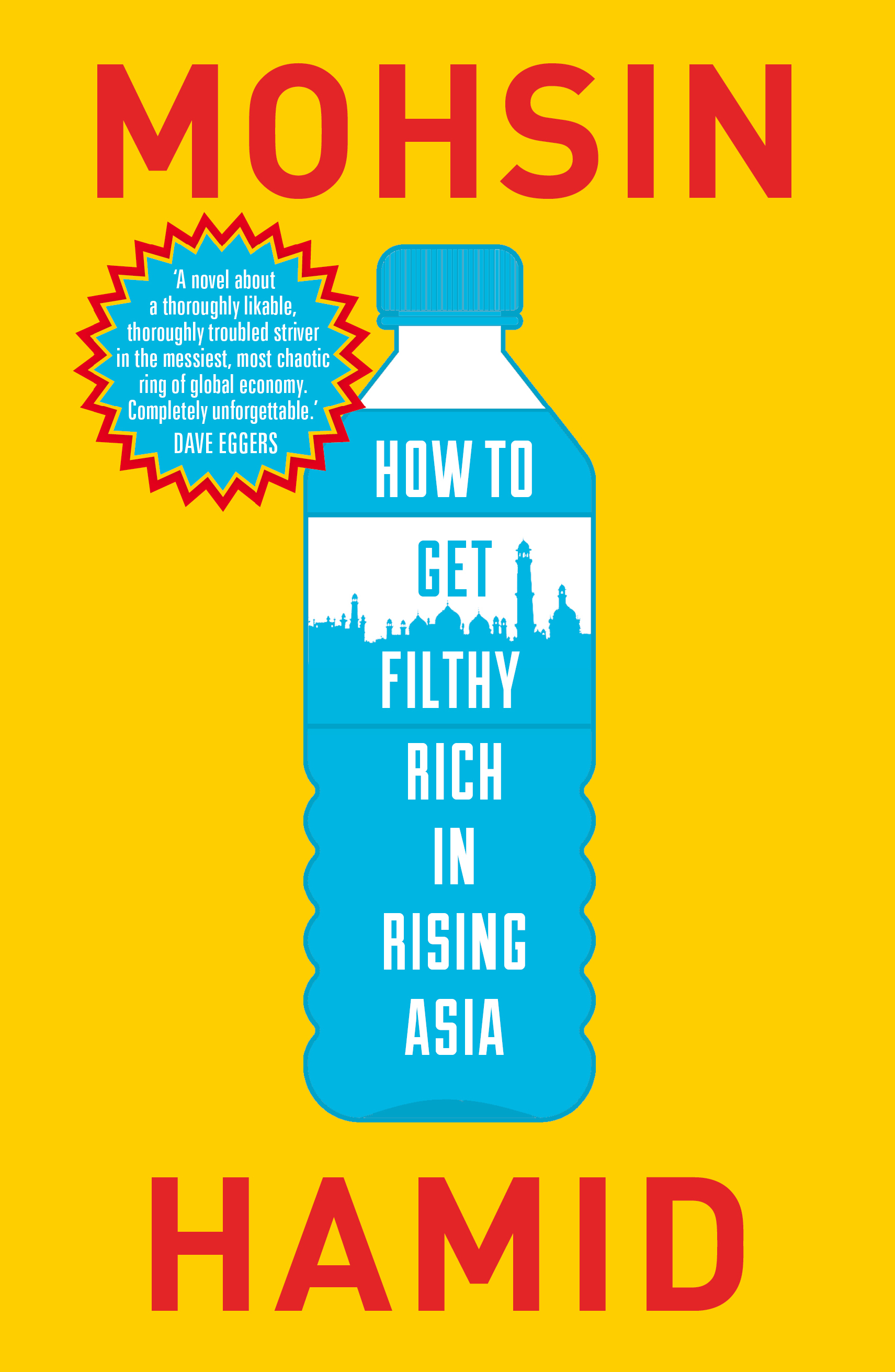
How to Get Filthy Rich in Rising Asia - Mohsin Hamid


No, this is not a self help book for ambitious people who have got it into their head that reading what rich fuckers have written will help them achieve their goal of becoming rick fuckers who write for other prospective rich fuckers to read and get inspired.

In fact this is anything but that.

And while, this may not be a book that warrants a full fledged review from my end owing to its short length and a lack of depth in story that I have come to associate with the writer's previous work as well (The Reluctant Fundamentalist)-but which nowhere becomes a hindrance during the read, mind you- this book is Mohsin Hamid at his sublime, free-flowing best.

His observations spot on, his language his sentence structuring most singular and his description of events and people so minimal that never does he use two words when one will suffice or two scenes when the description of a single static image will be strong enough to convey the author's heart-wrenching vision to the audience.

And what more, Hamid this time around employs an innovative narrative style of presenting the tale as a guidebook written in present tense where the reader is the protagonist and Hamid, the helpful voice plotting for them a way forward to successfully thriving in a present day city of the subcontinent. This certainly acts as icing to an already delicious cream cake (only to the literary eye of course).

Then there is the author's trademark high note ending to speak of, to discuss of, to debate on but more so- to simply cherish. An ending so perfect in the literary sense, it made me squeal in part elation part envy.

As a published book 'How to get filthy rich..' may not have anything new to offer in terms of story or ultimate purpose. But this is a must read if you have already tasted any of this true artist's previous works.

I found it intriguing. I hope you do too.

Tuesday, May 12, 2015

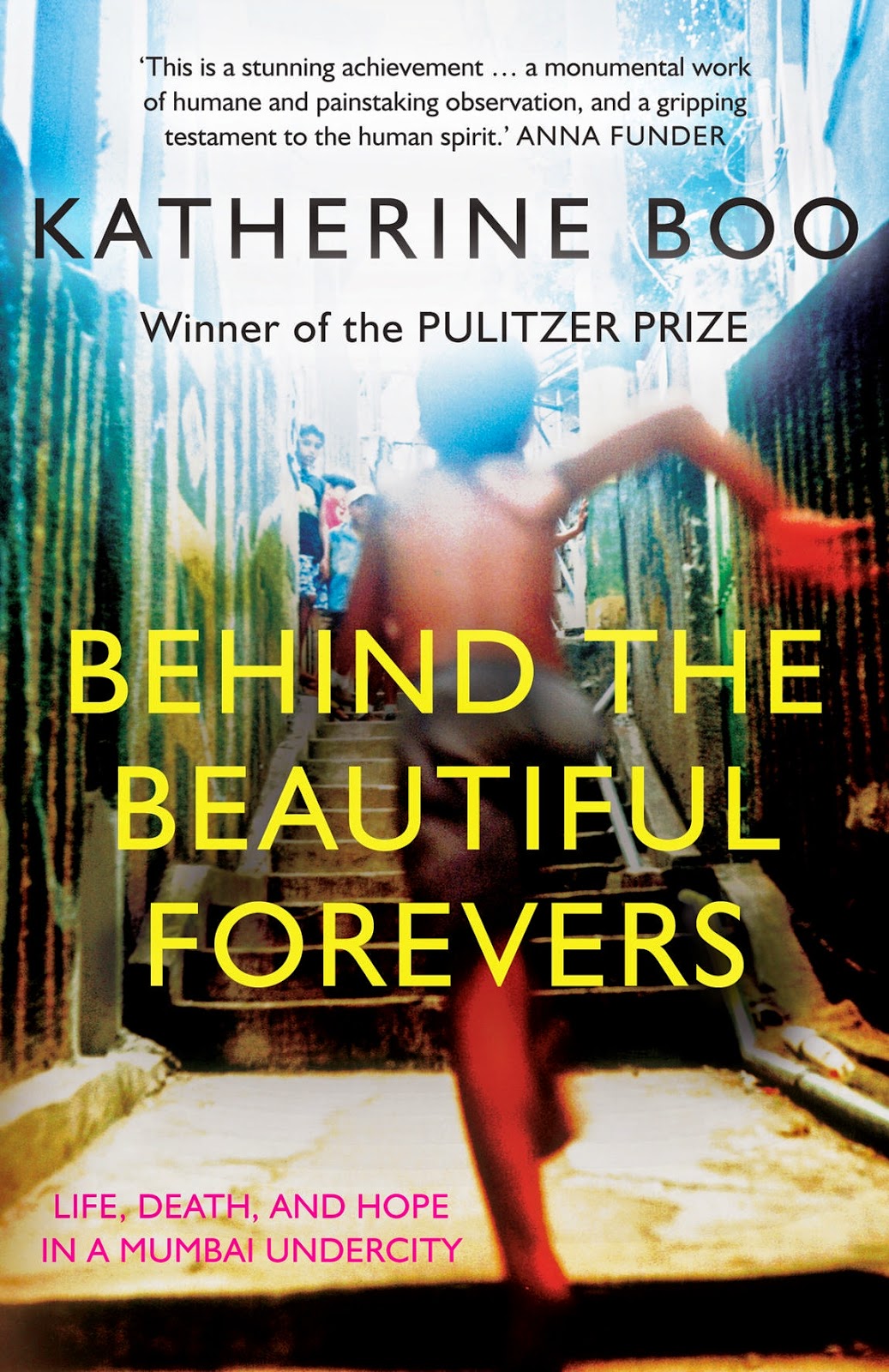
Behind The Beautiful Forevers- Katherine Boo


The first thought that strikes one’s mind on coming across a book that goes by the title ‘Behind the Beautiful Forevers- Life, Death & Hope in a Mumbai Undercity’ is – This is going to be one mushy narrative.

And when you do read it and when you do understand that this narrative is no ‘mush’- even though it’s not a lot of other better things either- you have to commend the writer for that (atleast). 

So, in my attempt to keep that principle intact, I mention the first thing first- this here is some serious writing. 

No soppy stuff involved, which meant that I could actually finish the book without rolling my eyes or yawning or wanting to do something else like picking my nose which- I believe- is a way more stimulating experience compared to reading crappy contemporary city-based romantic comedies produced by people whose claim of being writers is as unnatural as a guy claiming his right to romancing a goat (no religious angle intended).

Matters, most pertinent to the modern day existence of a person in Bombay, are presented in the book and what more, from the point of view of the underprivileged.

Poverty, corruption, greed for power and the resultant lack of access to the bigger picture which in turn results into petty ambitions and further lowering of living standards; Katherine Boo is able to competently present this vicious circle to the readers by documenting half a decade of the lives of slum-dwellers of Bombay, one slum to be specific- Annawadi, situated right on the outskirts of our city’s International Airport.

A teenaged garbage sorter falsely accused alongwith his family of burning their disabled neighbour to death, a habitually promiscuous one-legged woman who stretches her need for revenge a little too far, a middle aged mother aspiring to become the slumlord of Annawadi through any means available, her innocent daughter, and a few garbage scavengers living more hand-to-mouth than anyone else in Annawadi, form the primary troupe of characters. Through them, Boo demonstrates how difficult it is to move up in life when money controls even the most menial of tasks, when everything comes with a price tag and when people around you are only looking out for their own skin.

The more one attempts to go up, the steeper and more slippery it gets until that inevitable tumble happens in the form of an airport redevelopment plan threatening to bulldozer the slums, or a terrorist attack that wipes out half the city’s tourist magnetism, or a criminal case filed against a family member that runs into several months and costs everything saved.

As the author’s note at the end mentions, all characters and names are real and have been incorporated into the story based on rigorous research involving observation through physical presence, first person interviews, multiple third person interviews to cross-verify the facts and hundreds of RTI applications. Obviously now, one can’t complain about finding fault with the plot of the book given this explanation, unless one wants to embarrass himself.

So I won’t go there.

Nonetheless, it is time I move on to the not-so-nice part of my review, before a trusting reader is misguided by my words into believing this to be the next ‘White Tiger’.

What is a good ‘documentary’? And more importantly, in terms of the written word, what exactly can be said to be a good attempt at writing ‘creative non-fiction’?

For some, it could be one where enough has been covered of the subject matter. For others, it could be to what extent the piece of writing succeeds in proving the subject matter to be true, and to what extent it does not.  

For me, neither of the above count too high as parameters, especially when the piece of writing we are talking about is a full-fledged two hundred and fifty pages long.

The one basic filter that I would automatically want to apply on such a book is- Are the ‘people’ in the book becoming ‘persons’ for me while I’m reading? If the answer is negative, then I see no difference between reading the book and reading directly the facts and figures off a response to an RTI application.

Unfortunately, crossing this filter is not every writer or documenter’s cup of tea. For instance, one cannot simply create descriptions and events out of thin air to make this possible.

It requires the skill of knowing where to look instead of knowing what you want to look for. It requires the gift of neutral observation and secondly (and more importantly) the flair for a complete and honest noting of all observations so that what you write brings out the person you are writing about rather than the issue you wish to address.

And while, the author does manage to accomplish this to some extent with Abdul, the garbage sorter and a few others, there comes a point in the narrative, beyond which, it becomes quite blatant that the author is only writing of those portions of these lives that suit best her agenda of wanting to show a poor, divided, corrupt and power hungry Bombay (read as India-bashing), which is a silly way of approaching both the genre and the subject matter, unless you are writing a response to an RTI application and not a creative non-fiction book.

Another beef that I had with it was the lack of depth one would expect to come across given that Boo had FIVE years to observe ONE slum area in particular, not even the whole city, even if there are portions that deal with the problems faced by the city as a whole. By depth here, I mean the depth in depiction of the characters.

This, I could attribute to her being a foreigner, which would definitely have played a hurdle in her becoming acquainted with the inhabitants the way an Indian national could have with ease. But again, as I read through her note at the end, she talks on one page, of her belief that ‘devoting my attention to the handful of Annawadians who possessed a verbal dexterity that might have provided more colourful quotes' would have led to a more distorted presentation of the story. Which feels correct, albeit only to an extent.

For, it could be that what the reader is being deprived of due to her belief, is not only these colourful quotes which would have kept the interest levels alive but also the possibility of Annawadians being imagined by the readers as human beings having lives of their own instead of just some ‘poor, hungry people’ who face enormous quantities of hardships at every corner. Afterall, aren't imperfections and eccentricities what make us who we are? (infact, her description of court hearings, though only few, are quite evocative and memorable exactly because she captures these eccentricities alongwith the rest. So I'm even more surprised as to why she would refrain from doing it at other places too.)

Also, I believe a bigger length would have helped in fitting these enormous quantities of hardships into a more natural flow of events instead of forcing them together into big lumps from time to time, which just seemed counter-productive to the ultimate purpose of making the audience feel for the characters.

To sum it up, Katherine Boo’s ‘Behind the beautiful…’ is a well written book on the economic contrasts of our magnificent metropolis. But it has too many pages documenting the problems faced by poor people and too few pages documenting the poor people actually facing them.